7000 BC
Plot Tour Sign
Teosinte
~7,000 BC · Pre-Pioneer
Grows wild in Mesoamerica. The closest known wild relative of corn — despite looking nothing alike, teosinte and corn are nearly identical genetically. Bushy plants with many tillers, small triangle-shaped seeds enclosed in hard shells, crude ears on every branch.
Over thousands of years, indigenous farmers selectively bred teosinte into the corn we know today — one of the most remarkable feats of plant domestication in human history.
1924
Copper Cross
1924
Henry A. Wallace develops a hybrid called Copper Cross — a cross between Leaming and Bloody Butcher open-pollinated varieties — that wins the Iowa State Corn Yield Test. It proves that hybrid vigor can translate to the field. The commercial seed corn industry is about to be born.
1926
Hi-Bred Corn Company Founded
April 20, 1926 · Johnston, Iowa
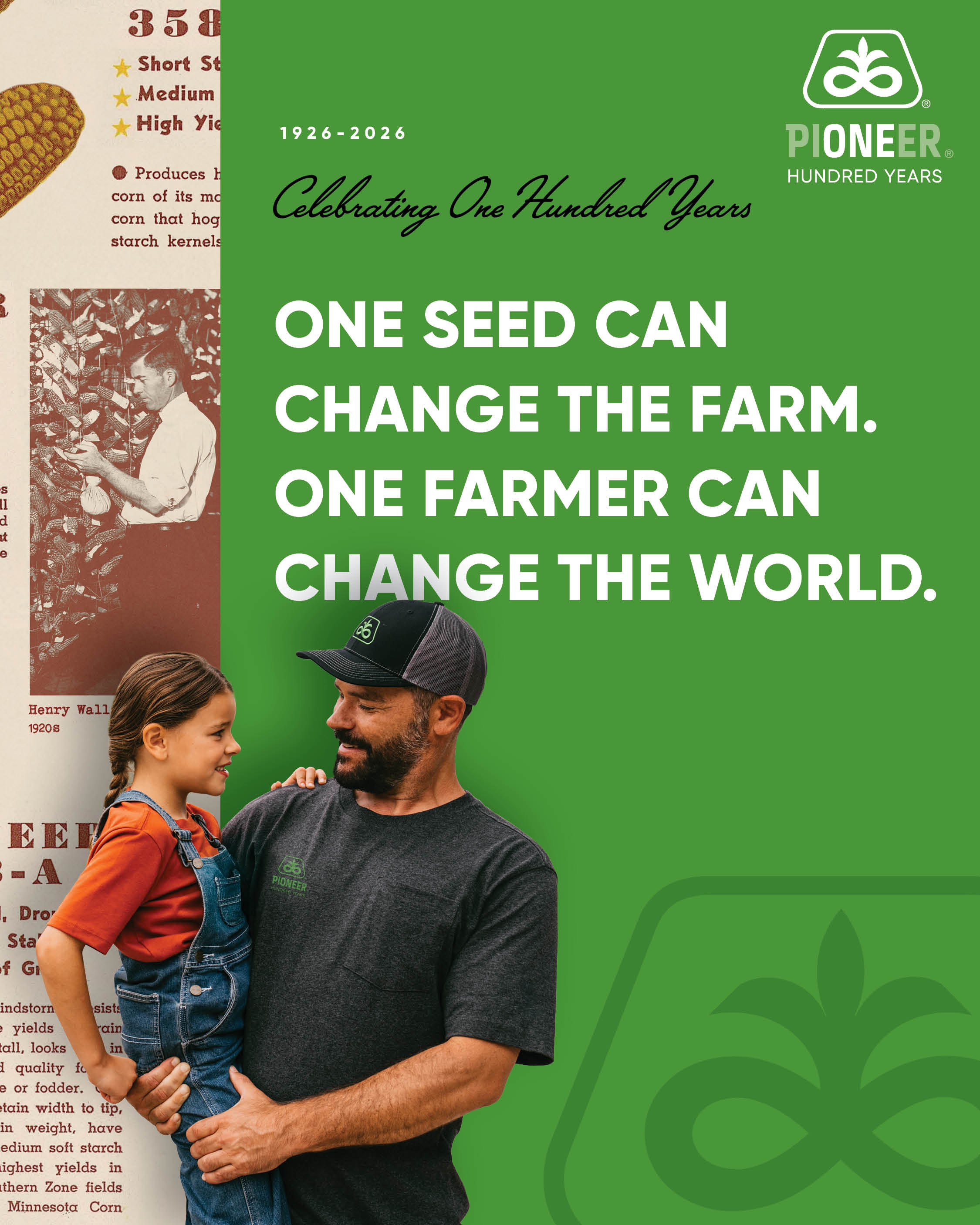
Henry A. Wallace, his brother James, and a small group of partners incorporate the Hi-Bred Corn Company — the first business in the world created specifically for developing and marketing hybrid seed corn. Wallace is 37 years old.
At this time, hybrid corn adoption is near zero. Farmers save their own open-pollinated seed. U.S. average corn yield: about 26 bu/acre.
1933
Wallace Joins the Cabinet
1933
Henry A. Wallace leaves Iowa for Washington, D.C. to serve as Franklin D. Roosevelt's Secretary of Agriculture. He turns day-to-day management of the company over to associates, but the foundation he built — research-driven hybrid development — continues to drive the company forward.
1935
"Pioneer" Added to the Name
1935
The company becomes Pioneer Hi-Bred, reinforcing its identity as an innovator. Hybrid corn adoption in Iowa stands at just 6% of planted acres — but the tide is turning fast.
By 1938, Iowa hybrid adoption hits 50%. By 1942, it reaches nearly 100%. The hybrid revolution is complete in just 16 years.
1941
Vice President of the United States
1941–1945
Henry A. Wallace becomes the 33rd Vice President of the United States, serving under FDR. A seed corn breeder from Iowa now holds the second-highest office in the nation. The company he founded continues to grow under professional management.
1940s
Feeding the War Effort
1940s
During World War II, Pioneer develops high-yielding hybrids that help secure the nation's food supply during global shortages. By 1949, Pioneer reaches one million units in annual sales — a major commercial milestone.
1960
McConnell Enterprises
Harold McConnell Joins Pioneer
1960 · Haxtun, Colorado
A Pioneer rep named Morse Johnson comes to Haxtun looking for someone to sell seed in the area. A local tells him to "go talk to McConnell, north of town." Morse finds Harold on his farm, busy getting steers ready for the county fair. Harold accepts the position — and later calls it "the best decision of my life."
The McConnell family's relationship with Pioneer begins. It will span three generations and more than six decades.
1964
The Iconic Trapezoid
1964
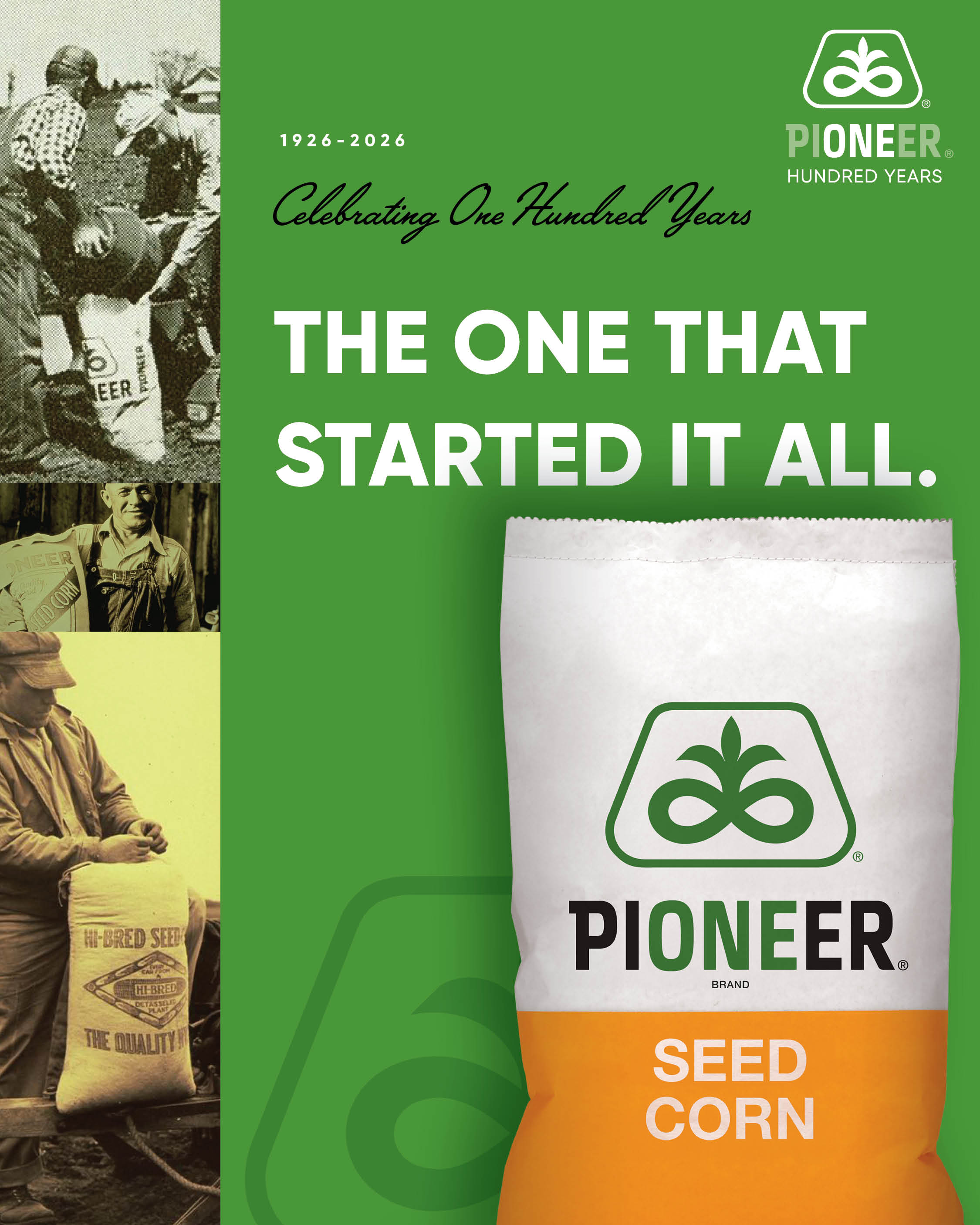
Pioneer introduces its iconic trapezoid logo — shaped like a flower and the symbol for infinity, representing constant vigor and unending growth through continuous research. That same year, seed bags transition from cloth to the now-familiar gold and white paper design.
The trapezoid becomes one of the most recognized symbols in agriculture, unchanged for over 60 years.
1970
Pioneer Hi-Bred International
1970
"International" is added to the name as Pioneer establishes joint ventures in Australia, Argentina, and South Africa. The company that started in a single Iowa county now serves farmers across the globe. By the late 1980s, Pioneer operates in 32 countries.
1973
Pioneer Goes Public
1973
Pioneer Hi-Bred International conducts its first public stock offering. The company also expands aggressively beyond corn into soybeans, wheat, sunflower, canola, and alfalfa throughout the 1970s.
1999
DuPont Acquires Pioneer
October 1, 1999
DuPont completes its acquisition of Pioneer Hi-Bred International in a $7.7 billion transaction. Pioneer becomes a wholly owned subsidiary with access to DuPont's deep research resources while maintaining its identity, brand, and farmer-first culture.
2000
McConnell Enterprises
Rick McConnell Becomes President
September 2000
Richard L. McConnell — Harold's son, raised on the family farm in Haxtun — is appointed President of Pioneer Hi-Bred International and Vice President of DuPont. The farm boy from northeast Colorado now leads the world's largest seed company. Twenty-six of his 30 years with Pioneer were spent in R&D.
2003
Herculex Insect Protection
2003
Pioneer launches Herculex, its first biotech trait platform for corn, providing above- and below-ground insect protection. A collaboration with Dow AgroSciences, it marks Pioneer's entry into the trait era — seeds that protect themselves.
2019
Corteva Agriscience
June 1, 2019
Following the Dow-DuPont merger, Corteva Agriscience spins off as an independent, publicly traded company. Pioneer remains the flagship global seed brand. For the first time since the DuPont acquisition, Pioneer's parent company is a pure-play agriculture company.
2023
Plot Tour Sign · P14830
623.89 Bushels Per Acre
2023 · P14830 (2011–Present Platform)
David Hula of Charles City, Virginia sets a new world corn yield record at 623.89 bu/acre using Pioneer genetics — more than 24 times the yield when the company was founded. The P14830 family delivers strong roots, stalk strength, drought tolerance, and fast grain dry-down.
U.S. average corn yield — bu/acre. Record is David Hula's Pioneer plot in Virginia.
2024
Plot Tour Sign · P13777Q
Vorceed Enlist
2024 · P13777Q (2011–Present Platform)
The Vorceed Enlist platform represents the most advanced corn trait stack Pioneer has ever commercialized. P13777Q delivers single-bag integrated refuge with multiple modes of action for above- and below-ground insects, plus tolerance to four herbicide active ingredients: 2,4-D choline, FOPs, glufosinate, and glyphosate.
Industry-leading yield performance. Excellent tar spot resistance. Average U.S. corn yield in 2024: 179.3 bu/acre — a new national record. Pioneer also sets a world soybean record at 218.29 bu/acre.
2026
A Hundred Years
April 20, 2026 · Johnston, Iowa
Pioneer celebrates its centennial at the Corteva Global Seed Business Center in Johnston, Iowa — the same community where Henry Wallace incorporated the Hi-Bred Corn Company 100 years earlier. David Wallace Douglas, Wallace's grandson, donates $100,000 to fund more than 100,000 meals for the Food Bank of Iowa.
Pioneer is the No. 1 corn and soybean brand in the U.S. by market share. U.S. corn yields have increased nearly 600% since the company's founding.
2026+
Plot Tour Sign
Future Innovations
2026 and Beyond
Yield & Yield Stability Trait: Proprietary genetic technology developed by Corteva to improve yield and yield stability under optimal growing, various soil types, and challenging seasons. Confers tolerance to important glufosinate alternatives.
Multi-Disease Resistance Trait: Gene-editing-enabled product with resistance to three key corn diseases for initial introduction. Broad-spectrum "in the seed" control helps growers manage year-to-year disease risk with design simplicity that allows rapid deployment across all bands and market segments. Field protection under even extremely high disease pressure.